

AVEO Oncology, an LG Chem company
Persevering for patients. Delivering a launch that beat expectations.
JFK at Work.
AVEO Oncology’s path to FOTIVDA® was anything but conventional. Following an earlier FDA setback for tivozanib, the company entered a new chapter under President and CEO Michael Bailey with a conviction that the drug still had an important role to play for patients with advanced kidney cancer.
That conviction required another major clinical and financial commitment. AVEO initiated TIVO-3, a new Phase 3 trial evaluating tivozanib in patients with relapsed or refractory renal cell carcinoma who had already received multiple systemic therapies. The study unfolded as the kidney cancer treatment landscape was changing rapidly, with immunotherapies and newer targeted agents reshaping earlier lines of treatment and raising new questions about how best to treat patients whose disease continued to progress.
For AVEO, the stakes extended far beyond another clinical trial. TIVO-3 represented an opportunity to address regulatory concerns from the company’s earlier U.S. development program while potentially establishing a new treatment option for a heavily pretreated patient population. The trial ultimately became the first positive Phase 3 study in third- and fourth-line RCC and included patients previously treated with immunotherapy.
As tivozanib moved toward its FDA decision, AVEO began preparing for multiple PDUFA scenarios. JFK Communications was brought in to lead corporate communications and public relations planning around this pivotal moment — helping AVEO prepare to communicate clearly and credibly whatever the FDA decision might be.
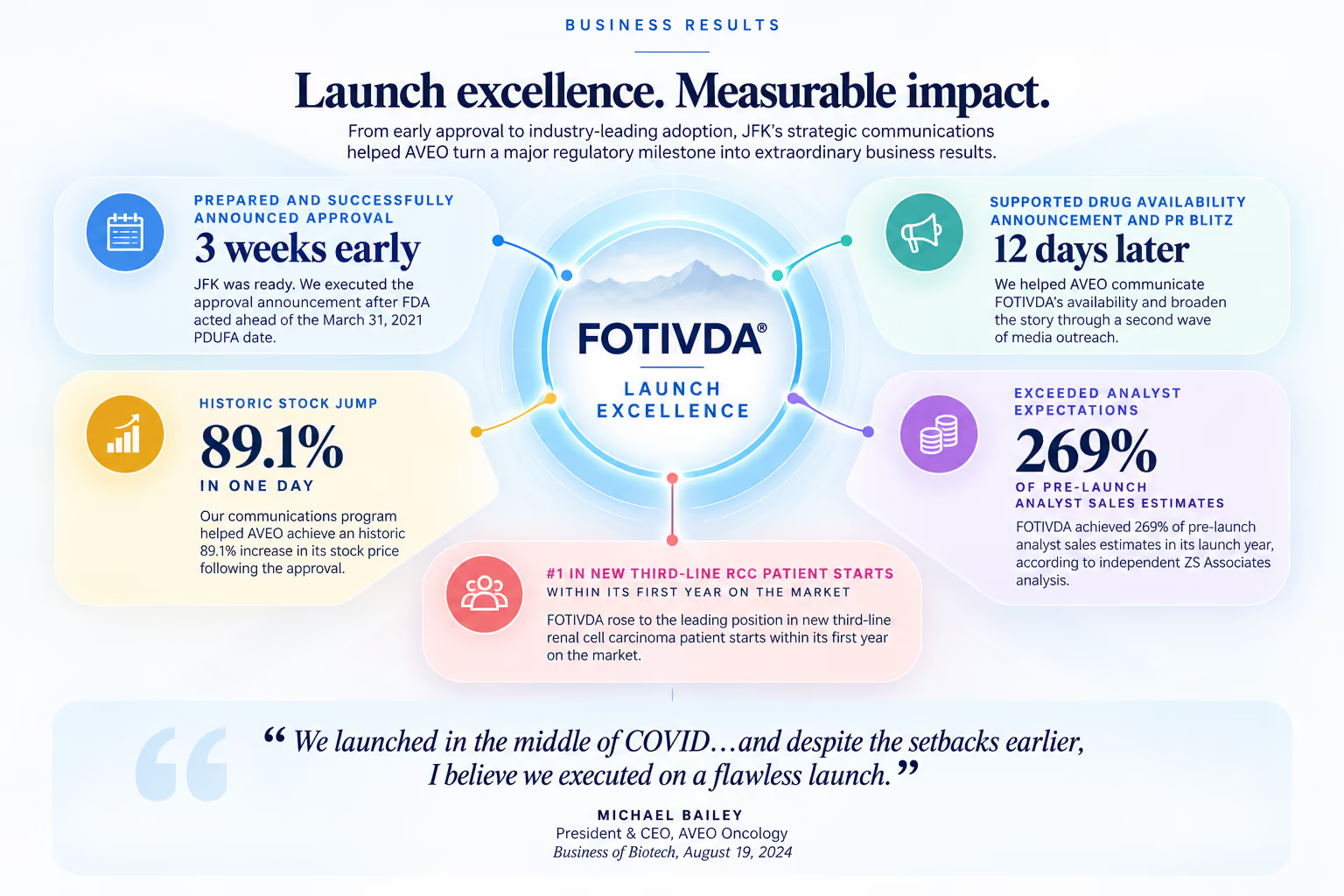
On March 10, 2021, the answer arrived: FDA approved FOTIVDA for adults with relapsed or refractory advanced RCC following two or more prior systemic therapies. Twelve days later, AVEO commercially launched its first U.S. product — in the middle of the COVID-19 pandemic.
That is where the JFK story really begins.
The challenge
AVEO Oncology was approaching one of the most consequential moments in its history: the potential FDA approval and commercial introduction of FOTIVDA® (tivozanib hydrochloride) for adults with relapsed or refractory advanced renal cell carcinoma following two or more prior systemic therapies.
The timeline was tight. Introducing a third-line oncology therapy would be challenging under any circumstances. Then COVID-19 changed virtually everything.
As the world moved into isolation and social distancing, AVEO leaned into a corporate culture centered on patients. Its teams continued preparing for FDA approval and pulled together the many clinical, regulatory, commercial and communications elements required to bring FOTIVDA to patients.
For communications, the workload was substantial. Press materials, messaging, graphics, broadcast-ready video, approved labeling and scores of other communications elements had to be developed, coordinated and moved through rigorous legal, medical and regulatory review — often simultaneously and against immovable deadlines.
JFK Communications brought experience supporting the FDA approval and commercialization of scores of oncology therapies. Working alongside AVEO’s leadership and commercialization teams, JFK provided both day-to-day communications leadership and the institutional oncology communications experience needed to anticipate requirements, navigate reviews and prepare for multiple FDA scenarios.
At the same time, the communications calendar wasn’t waiting. AVEO was preparing for ASCO and publication of the pivotal Phase 3 tivozanib data — creating another major scientific communications opportunity that had to be coordinated alongside regulatory and commercial-launch preparations.
The approach
Plan for the moment before the moment arrives.
Successful oncology launches don’t begin on approval day. JFK worked with AVEO well in advance of the FOTIVDA PDUFA date, using research, planning and scenario development to prepare the company for one of the most important communications moments in its history.
The work followed the regulatory journey — from NDA submission and FDA acceptance through preparations for the March 31, 2021 PDUFA date. At every stage, the objective was the same: anticipate what could happen, understand what each audience would need to hear and have the people, messages and materials ready before they were needed.
One story. Different audiences.
The science didn’t change depending on who was listening. The way it needed to be communicated did.
JFK worked with AVEO to develop and test messaging for oncologists, patients and advocacy communities, investors and the media. Spokespeople were identified and media trained well ahead of the FDA decision so AVEO could communicate confidently and consistently across audiences.
And approval wasn’t the only scenario. Communications plans also had to contemplate other potential FDA outcomes, including a Complete Response Letter or an extension of the regulatory timeline. Materials, messages, responsibilities and response protocols were developed accordingly.
Experience you can’t manufacture overnight.
Having supported the FDA approval of scores of oncology therapies, JFK brought institutional knowledge of both oncology communications and the FDA communications process to the assignment.
That included longstanding professional relationships with communications staff within FDA’s Center for Drug Evaluation and Research. JFK maintained appropriate communications with FDA press-office colleagues as the PDUFA date approached, helping the team understand communications procedures and prepare for the mechanics surrounding a potential regulatory announcement — without presuming or having advance knowledge of FDA’s decision.
Build the media strategy before there’s news.
FDA approval creates an extraordinary communications opportunity — but a regulatory milestone alone doesn’t guarantee meaningful coverage.
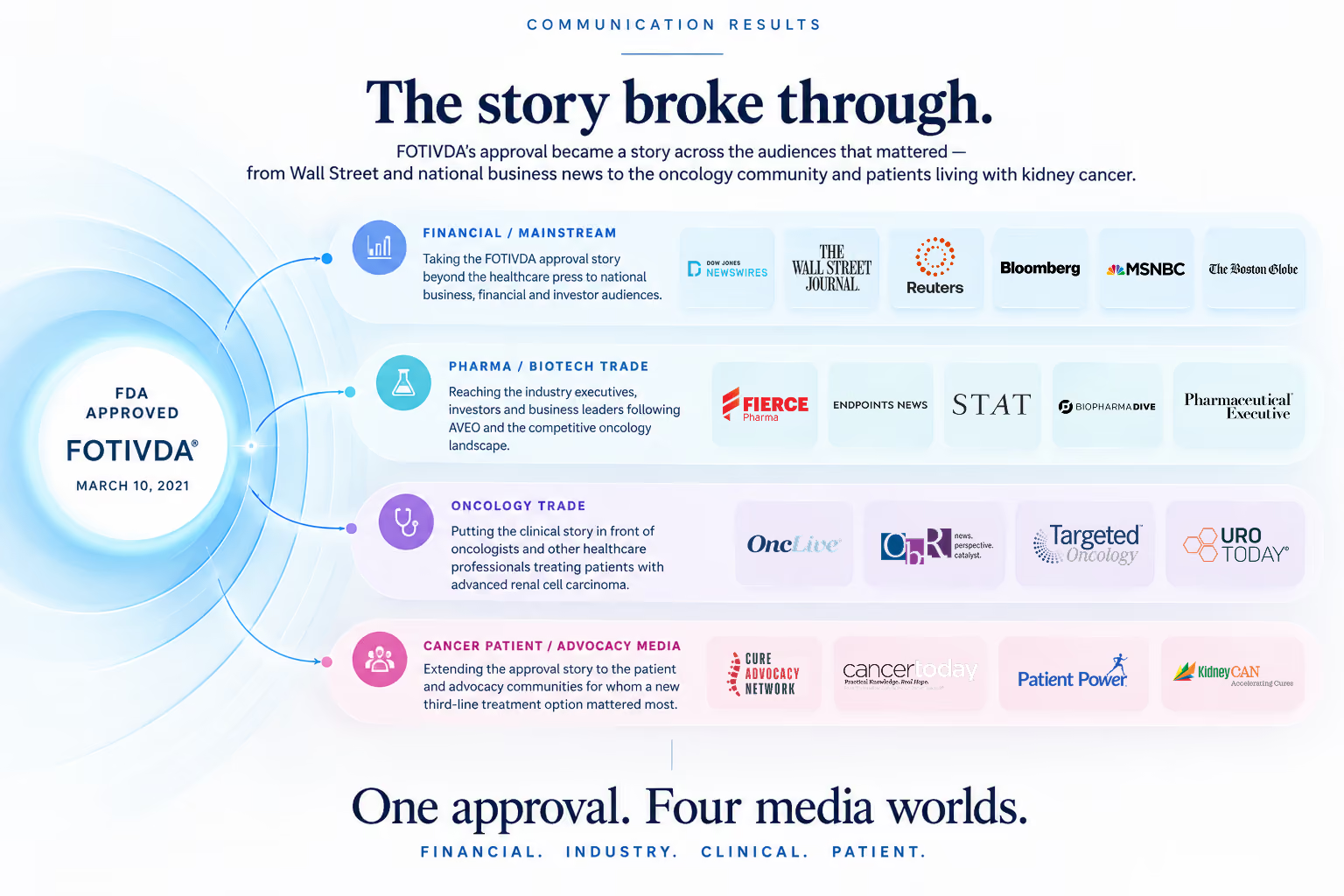
JFK developed a tiered media strategy designed to reach the audiences that mattered. The program included targeted outreach to major national business and financial media, including outlets such as The Wall Street Journal/Dow Jones, Reuters and CNBC; broad coverage across oncology and general medical trade media; and outreach to the extensive patient and advocacy media community.
The strategy went beyond distributing a press release. Reporters had different interests, deadlines and levels of familiarity with renal cell carcinoma. The communications team had to determine who needed the clinical story, who needed the business story, who needed the patient story — and how those pieces fit together.
Done well, media relations becomes a force multiplier for a launch.
One launch. One coordinated team.
PR couldn’t operate in isolation. JFK worked alongside AVEO’s corporate leadership, commercial, marketing and sales teams, as well as its advertising and other agency partners, to keep communications coordinated around the launch.
The program extended across earned and owned channels, with social media support for LinkedIn, Facebook and Twitter complementing media relations, executive communications and patient-focused outreach.
Meanwhile, the team was simultaneously preparing for ASCO and communications surrounding publication of the pivotal Phase 3 tivozanib data.
The result was a communications infrastructure designed to be ready for whichever FDA scenario occurred — and capable of moving immediately if FOTIVDA received approval.
The results
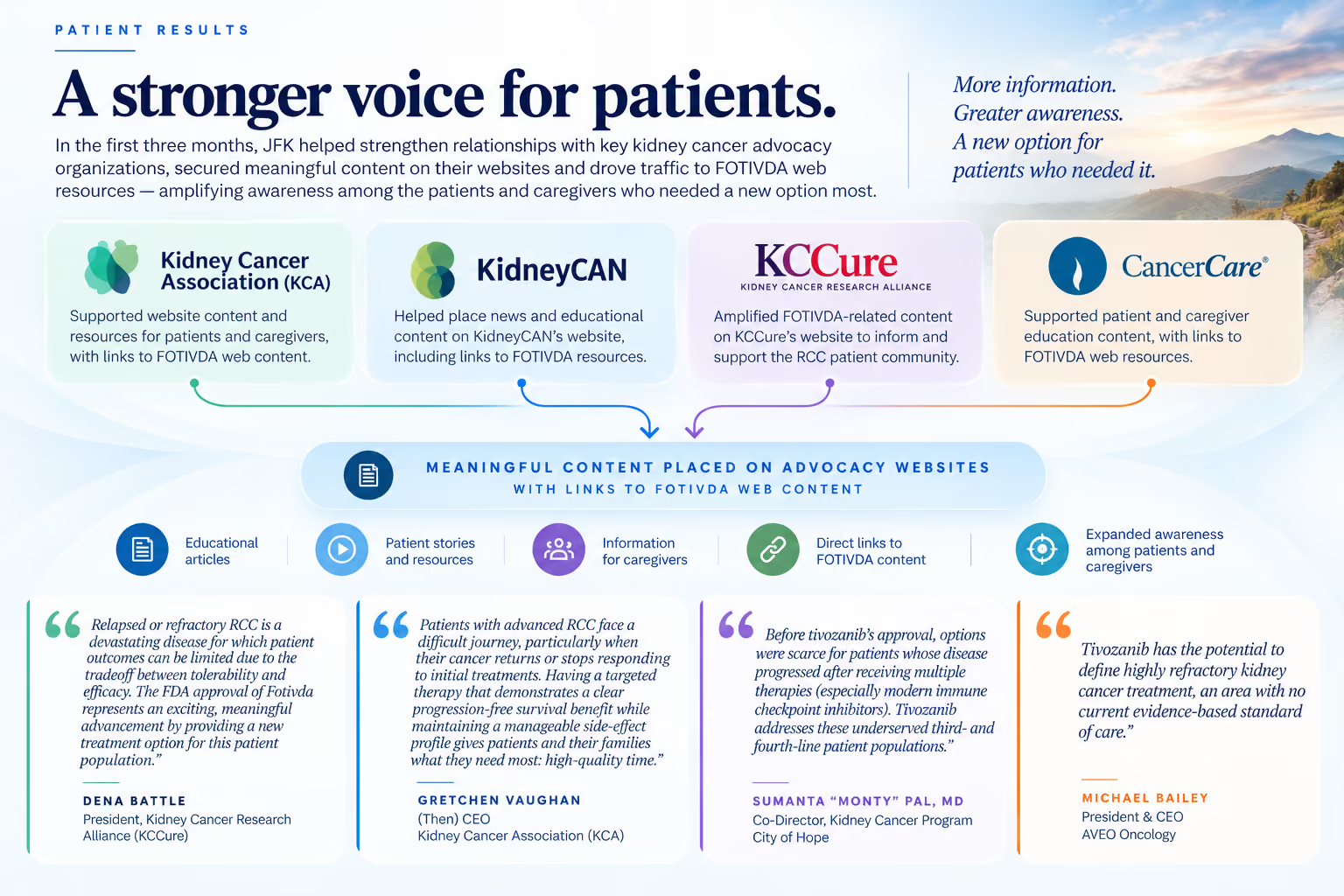
The results went beyond the headlines.
A successful launch had to do more than generate attention. It had to break through with the right audiences, support AVEO’s business objectives and, most importantly, help patients and caregivers understand a new treatment option.
The impact can be seen in three ways.
A breakthrough. A milestone. A challenge. An idea that deserves more attention. Tell us what’s next.